Student records (MIS or SIS)
The core record of who your students are, their classes, attendance and contacts.

Most schools don't run on one system. They use an MIS, a learning platform, an admissions tool, and a lot of spreadsheets. The real question isn't which product to buy. It's how the pieces fit together.
We've spent 20 years building education technology for over 10,000 schools in 155 countries. Here's how to think about your stack, and where we can help.

Education technology covers every job a school does, from the first enquiry to the last report card. Most schools need software in six areas:
The core record of who your students are, their classes, attendance and contacts.

Enquiries, applications, visits, offers, re-enrolment and alumni relationships.

Planning, assessment, gradebooks, reporting and communication with students and families.

Mapping what's taught, when and against which standards, so it holds together across year groups.

Activities, trips, bookings, payments and transport, plus keeping parents informed.

Turning everything above into answers your leadership team can act on.
You might buy all six from different providers. You might buy several from one. Either way, the quality of the connections between them decides how much time your staff spend re-typing data.
Every school software decision
comes back to this trade-off.
Each Faria product does one job in depth and can be bought on its own. When you add a second or third, they share data, so you get the benefits of a suite without being locked into one.
That means you can start where the pain is worst, keep the systems that already work, and grow at your own pace.
"We have been through a remarkable transformation by integrating ManageBac+, OpenApply and SchoolsBuddy."

Cindy Kong
Technical Engineer, Nanjing International School

Your MIS (or SIS, depending on where you are) holds the core student record. It matters. But it was never built to run admissions, plan a curriculum or tell a parent when the bus is late.
So when you're choosing or reviewing an MIS, ask a wider question: how will everything else connect to it?
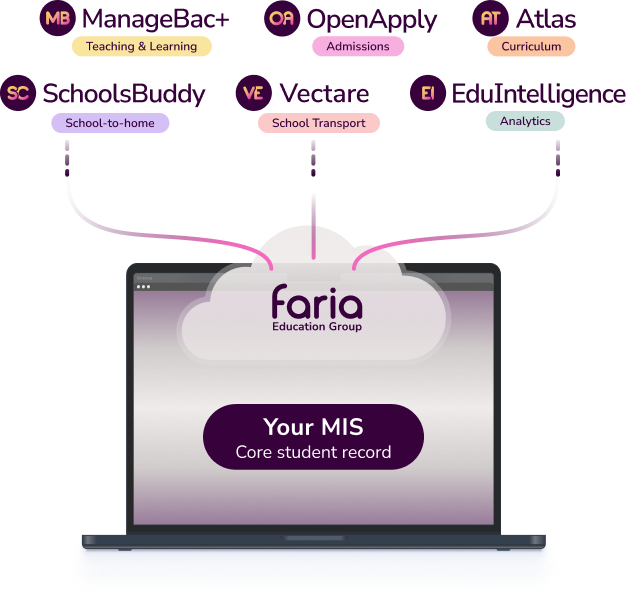
Student, class and staff data should flow in automatically, not be uploaded by hand each term.
An enrolled applicant should become a student record without anyone retyping it.
When a parent's email changes, it should change everywhere.
If you switch MIS in five years, your other tools should come with you.
Feature lists all start to look the same. These questions tell you more.
Ask for a list of live integrations, not a roadmap. Ask who fixes them when they break.
If the answer is no, you're choosing a suite whether you meant to or not.
You should be able to export it in a usable format, without a fee.
Find out if you'll have a named contact, and for how long.
Ask to speak to one with a similar curriculum, size and MIS.

You don't need to replace everything at once. Pick the problem costing you the most time, and start there.


Brings lesson planning, assessment, communication and reporting into one multi-curricular platform.
Most schools know their systems are holding them back long before they do anything about it. Switching feels risky, so it waits another year.
Our Switching hub is built for that moment. It covers a five-phase framework for the switch, how long it really takes, when to time it, and the questions to ask your old provider and your new one.
Can't see yours?Talk to our team.
EdTech, short for education technology, is any software or digital tool that supports teaching, learning or running a school. That includes learning platforms, admissions systems, MIS, curriculum tools, parent apps and analytics.
An MIS (management information system) and an SIS (student information system) both hold the core student record. MIS is the common term in the UK; SIS is more common elsewhere. An LMS (learning management system) handles teaching and learning: planning, assignments, assessment and reporting.
Neither is better by default. Suites reduce data silos but can lock you in. Best-of-breed gives you depth but can leave staff re-entering data. Look for specialist tools that connect well, so you get the strengths of both.
Yes. Many schools run our products alongside their current MIS, including iSAMS, PowerSchool and Veracross. Talk to us about your setup.
No. Each product can be bought on its own, and they work together when you add more.
It depends on scope, data readiness and the systems you leave behind. Our Switching hub covers a five-phase framework, realistic timelines and the questions to ask your old and new providers.