
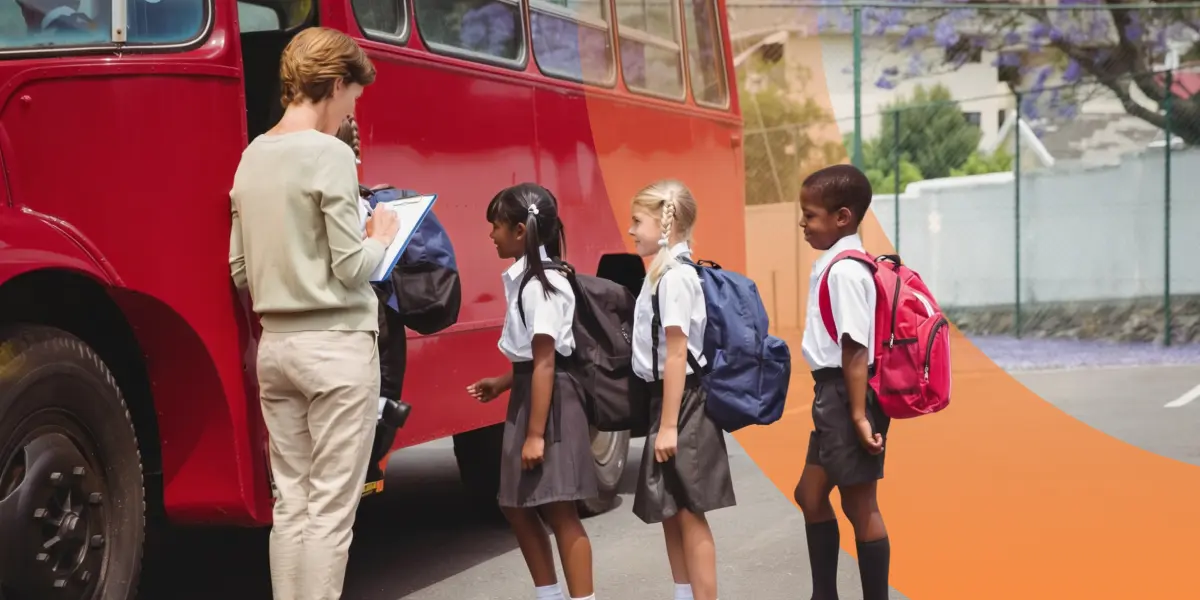
Your school has never been better at safeguarding inside its buildings. Attendance is logged digitally. Concerns are recorded and tracked. Your staff know exactly which pupils should be where, and you have clear protocols for when something goes wrong.
Then the bell rings, and the buses leave.
At that point, meaningful oversight of where your pupils are tends to stop. Not because you made a bad decision. Not because your safeguarding lead is careless. But because school transport has historically existed in a gap between your school’s responsibility and anyone’s actual visibility.
That gap has a name. Some in the sector are starting to call it the ‘transport safeguarding blind spot’. And it is more common than most schools would be comfortable admitting.
Think about how tightly managed your school day has become. Chances are you are running a minimum of three or four digital systems to manage attendance, welfare concerns, parent communication and behaviour incidents. Whether your school is inspected by Ofsted, CIS, BSO or any other accreditation body, the expectation is the same: a culture of safeguarding that is embedded, consistent and evidenced.
You have responded to that. Your training is better. Your recording is better. Your systems are more joined up than they have ever been.
But that culture tends to have a hard boundary. It stops at the school gate.
On any given afternoon, your pupils are travelling on buses, minibuses, taxis and shared transport services across routes that can span large geographic areas, involve multiple operators and mix pupils from different year groups. The driver may not know every child by name. There is rarely a staff member on board. Communication between the vehicle and your school, when it exists at all, is usually informal.
Most of the time, this works fine. The journeys are uneventful. Everyone arrives home.
But here is the thing. ‘Most of the time’ is not the standard you are held to in any other area of safeguarding. Transport sits in a curious position. It is routine enough to feel low-risk, but complex enough that when something does go wrong, the gaps in oversight become very visible, very quickly.
When something goes wrong during a school journey, four questions tend to matter most:
Try answering those questions right now, for yesterday’s afternoon run. For most schools, the honest answer involves phone calls, paper records, a conversation with a driver who may or may not remember, and a fair amount of uncertainty.
That is not a criticism of how you run your school. It is simply the reality of how school transport has been managed, because the tools and expectations that now govern in-school safeguarding have not, until recently, extended meaningfully to the journey itself.
Your parents’ expectations are shifting. In a world where they can track a parcel to their doorstep in real time, or watch the progress of a taxi on their phone, the idea that your school cannot confirm whether a child boarded a bus is increasingly difficult to explain at the school gate, let alone at a governors’ meeting.
Read more:If You Can Track Your Pizza, Why Can’t You Track Your Child?
Beyond parent pressure, the regulatory picture is getting clearer too. The Department for Education’s statutory guidance, Keeping Children Safe in Education, is explicit that children can be at risk of harm inside and outside of school, and that all practitioners should consider, at all times, what is in the best interests of the child. A pupil on a school bus falls within that duty. The guidance is clear. The practice, in many cases, has not caught up.
A child on your school bus is under your lawful control. The guidance is clear. The practice, in many cases, has not caught up.
Your blind spot exists, largely, because of a reasonable but flawed assumption: that because your school transport mostly goes without incident, your oversight arrangements are adequate. Routine breeds confidence. Confidence, over time, becomes complacency.
It is the same logic that used to apply to school trips. The Lyme Bay canoeing disaster of 1993, in which four teenagers from a Plymouth school drowned during an activity trip off the Dorset coast, prompted the first corporate manslaughter conviction in UK history and led directly to the Activity Centres (Young Persons’ Safety) Act 1995. Before that tragedy, activity centre safety was largely unregulated. Those trips were mostly fine too. Until they were not.
Transport safeguarding is at a similar inflection point. The question is whether you get ahead of it or respond to it after the fact.
There is no single answer that fits every school’s transport setup. But the starting point is the same for everyone: mapping the gap honestly. Asking whether your current arrangements would let you answer those four questions quickly and confidently. Checking whether your safeguarding policy actually covers what happens between your gate and your pupils’ front doors.
For schools that want to go further, we have put together a detailed guide covering the specific risk points in a typical school journey, a practical self-assessment framework, and what effective transport safeguarding looks like when it is working well.
You can download Safeguarding Beyond the School Gate here.